Does Reiki Actually Work? What the Science Says
July 2026 · Healing Ki Wellness · Master Amrita · 8 min read
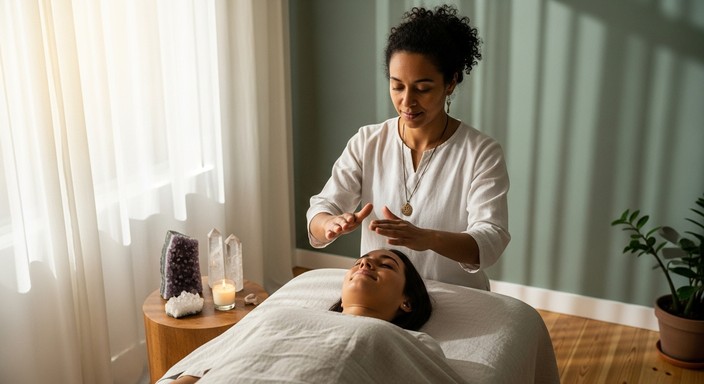
It's the question almost everyone asks before their first session, and often the one they're too polite to say out loud: does this actually do anything, or am I just paying to lie on a table for an hour? It's a fair question. Here's an honest look at what the research says, what it doesn't say, and why so many skeptics end up becoming regulars.
Why This Question Comes Up So Often
Reiki asks you to accept something you can't see — a practitioner's hands hovering near your body, "moving energy" you're told you might feel as warmth or tingling. For anyone trained to trust evidence over sensation, that's understandably a hard sell. The honest answer is that Reiki sits in a category researchers call complementary and integrative health: not a replacement for medicine, but a practice increasingly studied — and increasingly used — alongside it.
What the Research Actually Shows
Reiki has been the subject of a growing body of clinical research over the past two decades. Several patterns show up consistently across studies: reductions in self-reported pain and anxiety, measurable shifts in heart rate and heart rate variability, and lower cortisol (a primary stress hormone) following sessions. This is part of why major hospital systems and cancer centers — including academic medical centers with integrative medicine departments — now offer Reiki alongside standard treatment for patients dealing with surgery recovery, chemotherapy side effects, and chronic pain.
What the research does not show is a settled, universally accepted mechanism for how Reiki works at a biological level. That gap is part of why some scientists remain skeptical, even as patients and practitioners report consistent, repeatable benefits.
The Placebo Question
This is the fair pushback: could the benefits simply be the placebo effect, or the relaxation response any quiet, attentive touch might produce? Possibly, in part. But it's worth pausing on why that wouldn't make Reiki meaningless. The relaxation response is a real, measurable physiological state — lower heart rate, slower breathing, reduced stress hormones — and reaching it reliably has genuine value, regardless of the exact mechanism. If an hour of focused, intentional care shifts your nervous system out of fight-or-flight and into rest-and-repair, that's not "just" a placebo. That's your body doing what it's built to do, given the right conditions.
"I came during one of the most stressful periods of my life. After my first Reiki session, I felt something physically release from my chest. By the third session, my anxiety was manageable for the first time in years." — Sarah M., San Ramon, CA
Why Skeptics Often Change Their Mind
In our experience, people aren't convinced by an explanation of how Reiki works — they're convinced by what they feel during and after a session. A wave of unexpected emotion. Tension releasing in a part of the body they didn't mention out loud. The best sleep they've had in months. Once the body reports back, the mind tends to follow. If you'd like to know exactly what that first experience looks like, our guide to what to expect at your first Reiki session walks through it step by step.
Where Reiki Fits Alongside Medicine
Reiki is not a cure and shouldn't be presented as one. It's a complement — most valuable when it's supporting, not replacing, care from your doctor or therapist. People often turn to it specifically for chronic illness and pain management or for anxiety and stress relief, precisely the areas where the current research is strongest. If you're brand new to the practice, our beginner's guide to Reiki is a good place to start.
Frequently Asked Questions
Does Reiki actually work? Research on Reiki is still developing, but a growing number of studies suggest it can meaningfully reduce stress, anxiety, and the perception of pain by activating the body's relaxation response. Many hospitals and cancer centers now offer Reiki as a complementary therapy alongside conventional medical care, precisely because patients report real, measurable reductions in stress and discomfort.
Is there scientific proof that Reiki works? There is no single study that "proves" Reiki in the way a drug trial proves a medication works, largely because energy healing is difficult to study with a true placebo control. However, multiple peer-reviewed studies have found measurable shifts in heart rate variability, cortisol levels, and self-reported pain and anxiety after Reiki sessions, which is why it's classified as a complementary and integrative health practice by major health institutions.
Could Reiki's benefits just be the placebo effect? Some of Reiki's benefits likely do overlap with the relaxation response and placebo effect — and that's not a reason to dismiss it. Feeling cared for, slowing down, and activating the parasympathetic nervous system are real physiological events with real benefits, regardless of the mechanism.
Why do skeptics often change their mind about Reiki? Most skeptics who try Reiki aren't converted by theory — they're convinced by sensation. A felt shift in tension, an unexpected wave of emotion, or genuinely restful sleep after a session tends to speak louder than any explanation of how the energy works.
Can Reiki replace medical treatment? No. Reiki is a complementary practice, not a replacement for medical or mental health care. It works well alongside treatment from your doctor or therapist, supporting the body's stress response while your medical team addresses the underlying condition.